At its core, economic development is about more than sites, infrastructure and incentives. It’s about people and the stories that connect them.
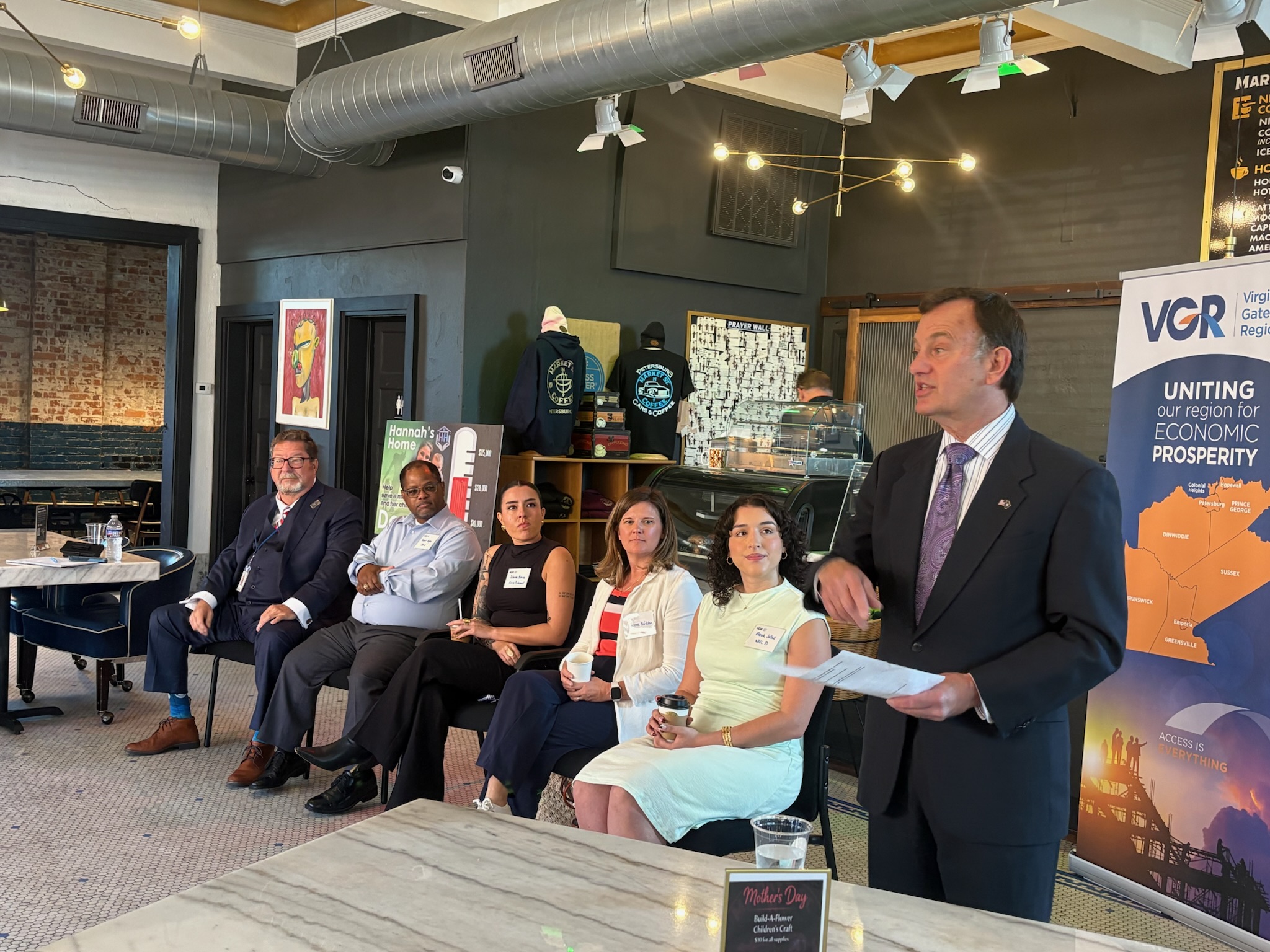
That idea was front and center at Virginia’s Gateway Region’s recent Coffee & Connect. This Business Council event brought together local leaders and media professionals for a candid conversation about how stories from across the region are shared, shaped and amplified.
Held at Market Street Coffee in Petersburg, the gathering created an environment where relationships could grow as naturally as the conversation. The Bank of Southside Virginia sponsored breakfast.
“What we really want to accomplish out of this is to build stronger relationships, stronger friendships and stronger voices making sure that our good stories are told,” VGR President and CEO Keith Boswell said in opening up the conservation.
Over the next hour, media representatives from broadcast and online outlets offered their perspectives on covering the Gateway Region – and how local businesses and leaders can draw attention to their news.
Relationships drive everything
Again and again, panelists returned to the foundational point that stories start with relationships.
“Relationships are the key to anything,” said Wayne Covil, who has been covering the Tri-Cities and Southern Virginia since arriving at WTVR 33 years ago. “A lot of times, that’s how stories come to life – not from random calls or social media, but from conversations.”
For a region as geographically broad as VGR, that matters. With fewer reporters covering more ground, connection becomes currency.
That means staying in touch beyond major announcements. It means inviting media into the region, not just pitching to them. And it means understanding that even when a story doesn’t land immediately, the relationship still holds value.
The story behind the story
If relationships open the door, relevance is what gets a story through it.
Panelists emphasized that too many pitches focus on announcements – new businesses, new projects, new investments – without explaining why they matter.
“It’s not enough to just say something is opening,” said Mariah Jallad, the Tri-Cities reporter for WRIC. “What’s the why? Why is it important? Why should people care?”
She recalled one of the first stories she covered in Petersburg was about a new bridal boutique. “But it wasn’t just about the bridal boutique,” she said. “It was about the revitalization of Old Town, of the historic district, and we were able to build it up in that way and still tell that nice story about that bridal boutique.”
Focusing on economic development, in particular, becomes more compelling when it moves beyond numbers. That “why” often comes down to people, such as workers training for new careers or small businesses contributing to larger revitalization efforts.
“It’s not all about the visuals of a plot of land or construction,” said Robert Hughes, assignment manager for WTVR, noting that Covil’s advocacy for a story plays an important role in what is covered. “It’s the person who’s going to have a better job because of it.”
For VGR, that’s an important shift. The region’s strengths, whether in manufacturing, logistics, pharmaceuticals or forestry, are powerful. But the stories that resonate are the ones that show how those industries change lives, Hughes added.
Connecting local news to broader trends will also get a reporter’s attention, from data centers and casinos to the daily pressures of housing costs. “We’re seeing people being priced out of the (Greater Richmond) counties and they’re looking at Petersburg – and that connects the region,” said Sabrina Moreno, part of the two-person Axios Richmond, which distributes a weekday newsletter.
Adrienne McGibbon of VPM News, which augments its broadcast with robust online news coverage, echoed that as the discussion focused on the region’s leadership in the state’s forestry industry. Now that Gov. Abigail Spanberger has established a Virginia Wood Council to bolster the $21 billion segment, what angles would make that story better connect with her audiences?
“So it’s not a story about the governor anymore,” she said, noting that recent forest fires in Georgia add other dimensions. For example, “From a banking standpoint, the forest fires will also affect both housing supply and prices.”
Make it easy to cover
Even the strongest story needs to be accessible.
With limited staff and constant deadlines, reporters look for pitches that are clear, concise and actionable. That means having the pieces ready to go.
As one newsroom leader explained, “If it doesn’t get discussed, we’re not talking about it. If we’re not talking about it, we’re not assigning it.”
That simple reality underscores the importance of preparation. A strong pitch includes not just the idea, but the elements that bring it to life: who to interview, what visuals are available, and why now is the right time.
Increasingly, traditional reporters are finding leads from social media. “Inflencers, yes, I know it’s controversial – but that is what’s really changing how people view places,” Moreno said. “That’s how I start seeing things, and I love those stories.”
The opportunity ahead
If there was a shared sense in the room, it was that Virginia’s Gateway Region is often under-told, not under-performing. In fact, Covil called out a handful of “good news” stories at the ready, from the opening of a new brewery and its economic development benefit for Hopewell to rich history that extends more than 250 years – not just a slice that includes the Civil War.
“You’ve just got to have the stories being pitched,” he added.
McGibbon recalled several stories that have attracted her to the Gateway Region from a Petersburg farmer teaching young students about growing fruits and vegetables for healthy eating to a local woman collecting donations for victims of Hurricane Helene.
“We’re looking to tell the stories of the people who live in the communities,” she noted.
Boswell concluded the event stating, “We continue to tell the story of the region’s economic transformation and look forward to our media partners to join in the storytelling.”